How to tell if a diamond is real with a flashlight
By Nico Melian, developer of the Diamond Tester app
Short answer
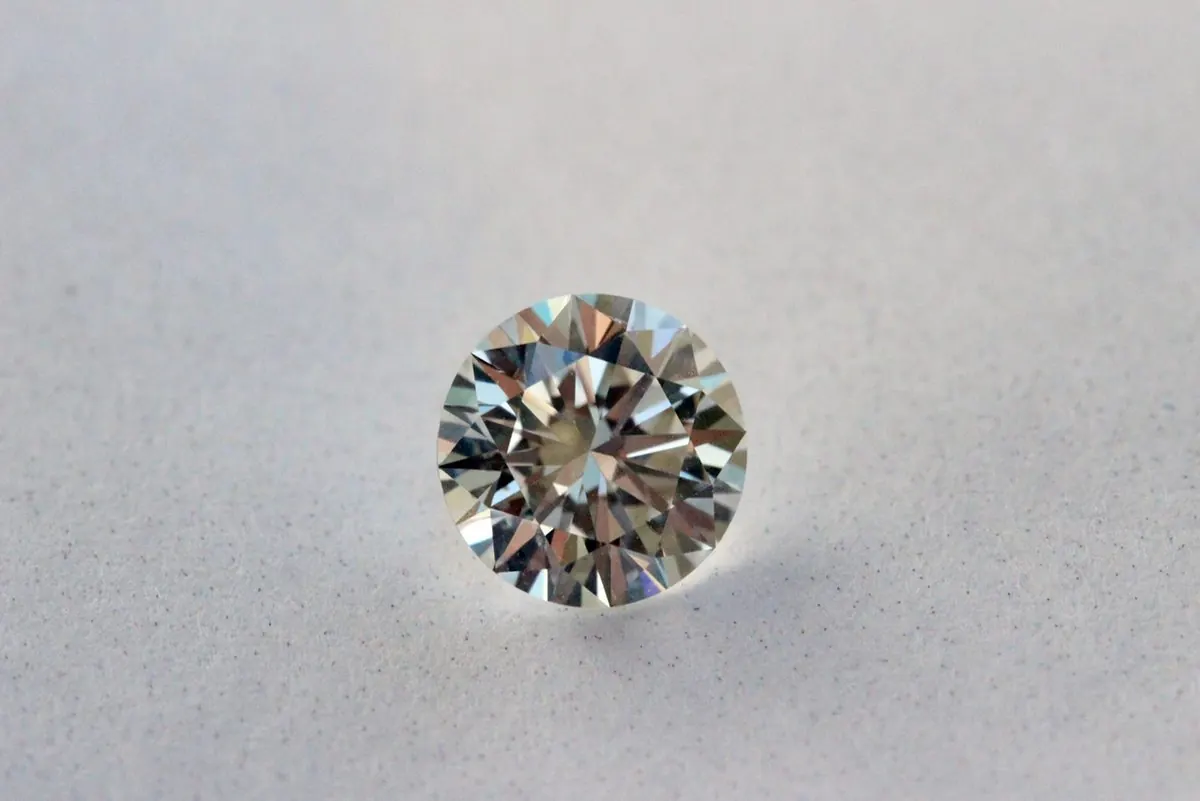
The internet version of this test says a real diamond reflects white light and a fake throws rainbows. That is half wrong. A well cut diamond throws plenty of color. What matters is the balance between white flashes and colored flashes, and how much light comes back at all. Here is how to run it properly and how to read what you see.
How to do the flashlight test
- Clean the stone first. Skin oil and lotion on the pavilion kill the light return of any stone, real or not. Warm water, a drop of dish soap and a soft brush, then dry it. Our cleaning guide covers the details.
- Find a dark room. The test only works when the flashlight is the only light source. Daylight and ceiling lights wash out the pattern.
- Use a small, bright, white beam. A phone flashlight works. Avoid warm yellow bulbs, which tint everything.
- Shine it straight down through the top (the table). Hold the light 6 to 12 inches above the stone. Then rock the stone slowly, or move the light a few degrees each way.
- Watch two things: how much light jumps back at you, and what color it is.
- If you can, repeat with a stone you know. A known diamond or a known cubic zirconia next to the suspect stone is worth more than any description you will read.
What you will see, and what it means
Three optical effects decide the result. GIA uses the same terms when it grades cut: brilliance (white light coming back), fire (light split into spectral colors) and scintillation (the on and off sparkle as the stone moves).
| What you see | Most likely | Why |
|---|---|---|
| Bright white flashes with some color, crisp on and off sparkle | Diamond, or a good diamond imitation | Diamond returns a lot of white light and a moderate amount of fire |
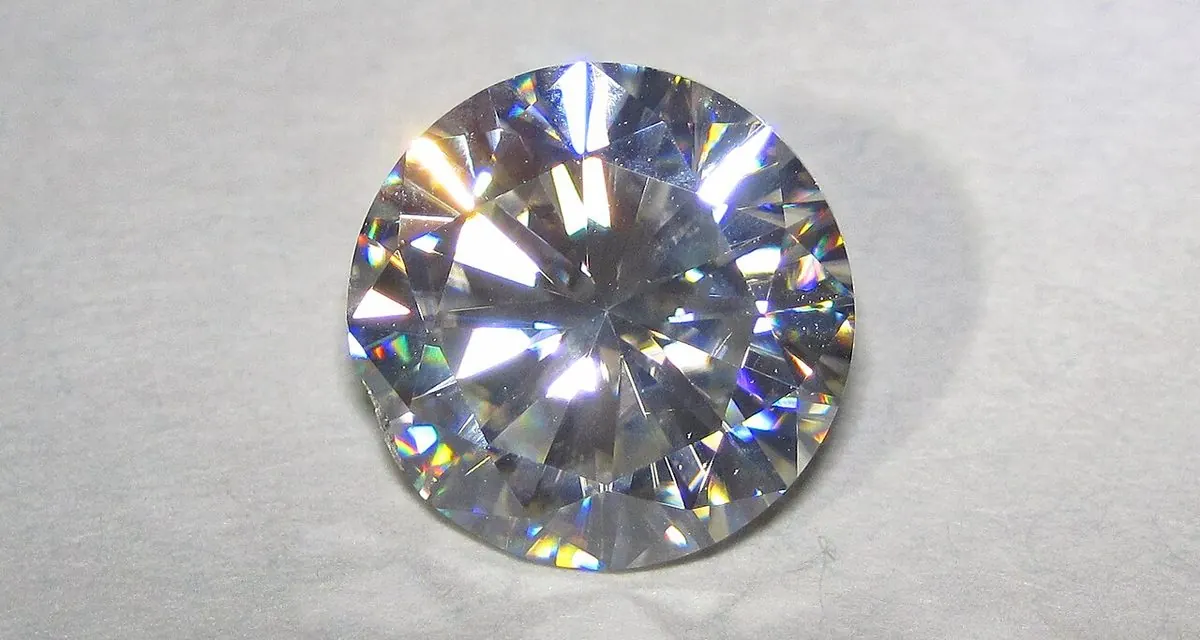
| Heavy rainbow, colored flashes everywhere, almost disco ball | Moissanite (or strong CZ) | Moissanite disperses light about 2.4 times as much as diamond |
| Colorful but softer, slightly glassy or milky look | Cubic zirconia | Lower refractive index than diamond, so less light comes back |
| Dull, light leaks through, little sparkle at all | Glass, or a diamond that is dirty or badly cut | Glass bends light far less; dirt and poor cut leak light out the back |
| Dark center when looking straight down | Badly cut stone of any type | Too deep or too shallow pavilion lets light escape |
The numbers behind the sparkle
You do not need physics to run the test, but the numbers explain why it works on some stones and fails on others. Refractive index (RI) measures how strongly a material bends light. Higher RI means more light bounces back to your eye. Dispersion measures how much white light splits into colors. Higher dispersion means more rainbow.
| Stone | Refractive index | Dispersion | Flashlight look |
|---|---|---|---|
| Diamond | 2.42 | 0.044 | Strong white, moderate color |
| Moissanite | 2.65 to 2.69 | 0.104 | Strong white, heavy color |
| Cubic zirconia | 2.15 to 2.18 | 0.058 to 0.066 | Softer white, more color |
| Glass | about 1.5 | low | Weak, light leaks through |
Moissanite figures come from GIA's 1997 study of the material when it first reached the market. That table is the whole story of the flashlight test. Moissanite actually returns more light than diamond, so "brighter" is not a sign of real. Its giveaway is the extra color. Cubic zirconia has more fire than diamond but less brilliance, which GIA describes in its overview of simulants. Glass loses on both counts.
Why the flashlight test fails
Four things wreck the result, and they show up constantly in real rings:
- Dirt. A film of grease on the underside can make a real diamond look as dull as glass. Clean it before you decide anything.
- Cut quality. A poorly cut diamond leaks light and looks lifeless. A well cut CZ can look lively. Cut changes the result more than the material does in many cases. See diamond cut grades.
- Size. Small stones, under roughly a quarter carat, show too little fire to judge by eye. The test is close to useless on pavé and melee.
- Lab grown diamond. A lab grown diamond is diamond. It has the same RI and dispersion, so it behaves exactly like a mined diamond under a flashlight. No home light test separates them. If that is your question, read are lab grown diamonds real.
Better tests to run after the flashlight
If the flashlight left you unsure, these are the next steps, from free to definitive. Each one rules out something the beam cannot.
| Test | Cost | What it adds |
|---|---|---|
| Fog test | Free | Diamond sheds heat fast, so breath fog clears almost instantly |
| Newspaper test | Free | Loose stones only. Print is unreadable through a diamond |
| 10x loupe | A few dollars | Look for doubled facet edges (moissanite) and worn, rounded edges (CZ, glass) |
| Jeweler's multi tester | Usually free in store | Thermal plus electrical probe, separates moissanite from diamond |
| Lab report (GIA, IGI) | Paid | The only way to confirm natural vs lab grown and the real grades |
The loupe step matters most for moissanite. Moissanite is doubly refractive, so looking through the stone at an angle you can see the back facet edges doubled. GIA flagged this doubling as the easiest way to separate it from diamond back in 1997. Diamond is singly refractive and never doubles. Our page on diamond vs moissanite walks through what that looks like.
The UV flashlight variation
Some people run the test with a UV (black light) flashlight instead. Many diamonds glow under long wave UV, usually blue. GIA studied more than 26,000 diamonds and found about 25 to 35 percent show some fluorescence, and more than 95 percent of those glow blue. So a blue glow is consistent with diamond, and no glow tells you nothing: two thirds of real diamonds do not react. Some simulants glow too. Use it as a curiosity, not a verdict.
Loose stone vs a stone in a ring
The test reads differently depending on whether the stone is set. A loose stone lets you look at it from every angle and compare it directly with a reference stone on the same white card. That is the easy case. A set stone is harder for three reasons.
- The setting blocks light. Closed back settings, bezels and heavy prongs stop light from entering the pavilion. Even a real diamond looks darker in a closed back.
- Metal reflects into the stone. Yellow gold tints the light that comes back. Do not read a warm look as a sign of anything.
- You cannot compare side by side. Holding a ring next to a loose reference stone is not a fair test because the two are lit differently.
For a set stone, the flashlight is most useful for spotting the extreme cases: heavy rainbow that points to moissanite, or a flat, glassy return that points to glass. Everything in between needs a loupe or a tester. An old ring with a closed back setting is also worth a closer look on its own: jewelers in the past sometimes backed foil behind imitation stones to fake brilliance.
Our take
Run the flashlight test because it costs nothing and takes a minute. If the stone looks like a disco ball, suspect moissanite and check for doubled facet edges. If it looks dull even when clean, suspect glass. If it looks like a diamond, you have learned that it is not obviously fake, which is a long way from real. For anything you paid real money for, finish with a jeweler's multi tester, and for anything you will insure or sell, a lab report. The full list of home tests, ranked by how much they prove, is in how to tell if a diamond is real.
FAQ
Do real diamonds sparkle rainbow under a flashlight?
Can a flashlight tell a lab grown diamond from a natural one?
What does a fake diamond look like under a flashlight?
Is the flashlight test reliable?
Sources
Worth being clear: everything here, and the app itself, is an educational reference. At-home tests narrow things down, they do not certify a stone. Before you buy, sell or insure anything of real value, get it looked at by a certified gemologist or an independent appraiser.
Want a second opinion on the stone in your hand?
Diamond Tester reads a photo and gives you its visual take on the stone, the 4Cs and a value range, plus what to check next. It does not replace a jeweler's tester or a lab report. First scan is free on iOS and Android.


Keep reading
Eight at-home tests ranked by how much they prove.
Diamond vs moissaniteHow to tell the two apart at home.
The fog testHow to do it and what it proves.
Moissanite vs lab diamondTwo lab-made stones, one of them a diamond. Who should buy which, with the numbers that decide it.
Are lab grown diamonds real?Same carbon, same crystal, same tester result. The legal answer, the physical answer, and the resale answer.