How do diamond testers work?
By Nico Melian, developer of the Diamond Tester app
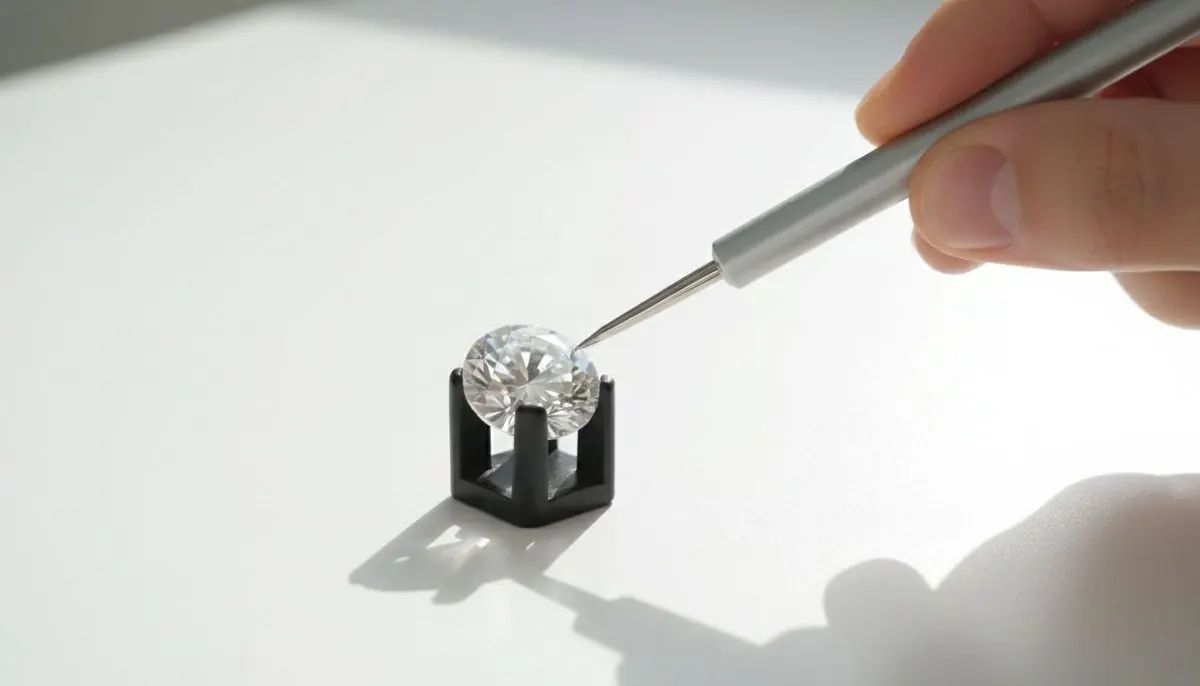
In one paragraph
The pen-shaped testers sold online and the bench units jewelers use look different, but nearly all of them work on the same two principles. Once you know what each one measures, you know which stones fool it and how much a beep is worth.
Type 1: thermal conductivity testers
What it measures
Diamond conducts heat better than almost any other material. A thermal tester has a tiny metal tip that heats up. When you press the tip against the stone, the tester measures how quickly heat drains out of the tip. Diamond draws heat away very fast. Glass, cubic zirconia, white sapphire and most other simulants draw it away slowly. The pen converts that into a row of lights or a beep.
What fools it
Moissanite. GIA's 1997 study of the material found its thermal properties are so close to diamond that the thermal probes on the market react to it as if it were diamond. That single fact is why thermal-only pens are no longer enough on their own. Metal is the other trap: if the tip touches the prongs or the band, the metal pulls heat away and the pen reports diamond on almost anything.
Type 2: electrical conductivity testers
What it measures
Moissanite is silicon carbide, a semiconductor. It lets a small current pass. Gem quality diamond is an electrical insulator. An electrical tester (often sold as a moissanite tester) sends a small current through the tip and checks whether it flows. Current flows: moissanite. No current: not moissanite.
What fools it
Diamonds that contain boron. These are called type IIb diamonds, the category that includes most natural blue diamonds, and the boron makes them conduct electricity. Some lab grown diamonds made by the HPHT method also contain boron. An electrical tester can flag those as moissanite. It is rare in a typical white engagement stone, but it happens, and jewelers know to look for it.
Type 3: multi testers
A multi tester runs the thermal check and the electrical check in one probe. Thermal says "diamond or moissanite," electrical splits the two. This is what most jewelers reach for today, and it is the minimum worth trusting for a quick in-store answer.
What each tester says about each stone
| Stone | Thermal tester | Electrical tester | Multi tester |
|---|---|---|---|
| Natural diamond | Diamond | Not moissanite | Diamond |
| Lab grown diamond | Diamond | Not moissanite (boron stones can read moissanite) | Diamond |
| Moissanite | Diamond (fooled) | Moissanite | Moissanite |
| Cubic zirconia | Not diamond | Not moissanite | Not diamond |
| White sapphire | Not diamond, sometimes a weak reading | Not moissanite | Not diamond |
| Glass | Not diamond | Not moissanite | Not diamond |
Read the table by row and the gap jumps out: no handheld tester has a column for natural versus lab grown. That separation needs spectroscopic screeners or a full lab. GIA notes that some lab grown stones need advanced instruments that read strain patterns, trace elements and fluorescence. Our lab grown guide covers how origin gets confirmed.
How to use a tester pen without fooling yourself
Most wrong readings at home come from technique, not from the pen. Follow this order:
- Read the manual for warm up and calibration. Many thermal pens need a short warm up and some ask you to set the ambient temperature or stone size.
- Clean and dry the stone. Oil and water films change heat flow.
- Let the stone sit at room temperature. A ring just taken off a warm finger reads differently from a cold one.
- Hold the tip at a right angle to the table facet with steady, light pressure. Do not touch metal. On small stones this takes practice.
- Hold the metal part of the pen (or the ring) if the instructions ask you to. Many units need you to complete the circuit through your hand.
- Test a few times and wait between tests. Repeated contact warms the stone and drifts the reading.
- Check the battery. A weak battery gives weak, unreliable readings on many cheap pens.
Common false readings
| What happened | Likely cause |
|---|---|
| Everything beeps as diamond, even glass | Tip touching metal, or pen not calibrated |
| Known diamond reads low or as simulant | Dirty stone, warm stone, weak battery, tip not flat on the facet |
| Diamond reads as moissanite on an electrical probe | Boron containing (type IIb) diamond, or tip touching metal on some units |
| Moissanite reads as diamond | You are using a thermal only pen |
| Tiny stones give random results | Tip larger than the facet, contact unstable |
Where to get a stone tested
Owning a tester is optional. Plenty of people already have better equipment and will use it on your stone. What you get depends on who you ask.
| Where | What they usually do | What you get |
|---|---|---|
| Retail jeweler | Multi tester and a loupe check | Diamond, moissanite or neither, often free |
| Pawn shop or gold buyer | Multi tester | A quick answer, plus an offer if they want to buy |
| Independent appraiser | Testing, measuring, grading estimate | A written appraisal for insurance, for a fee |
| Gemological lab (GIA, IGI) | Full identification and grading | A report with origin and the 4Cs |
Two rules. First, ask which tester they used; a thermal only result does not rule out moissanite. Second, for a stone you plan to sell, get the answer from someone who is not also making you an offer. An independent appraiser or a lab has no reason to talk the stone down. Our page on what your diamond is worth covers the selling side.
Should you buy one?
Our position, based on what these devices measure:
- Buy a multi tester if you regularly handle secondhand jewelry, estate pieces or pawn lots. Thermal only pens are close to worthless today because they cannot see moissanite.
- Skip it if you have one ring to check. A jeweler will test it with better equipment, usually for free, and a lab report beats any pen.
- Never treat a beep as a valuation. A tester says diamond or not diamond. It says nothing about clarity, color, cut, carat or origin, which are what set the price. Our 4Cs guide explains why.
What to do with the result
If a multi tester says diamond, you have ruled out the common simulants. Next question is natural or lab grown and the grades, which needs a lab report if the stone is valuable. If it says moissanite, check for doubled facet edges with a loupe; we explain how in does moissanite pass a diamond tester. If it says neither, the stone is most likely cubic zirconia, glass or white sapphire, and our list of signs of a fake diamond will help narrow it down. For a full set of checks with no equipment at all, use how to tell if a diamond is real, and for the moissanite question specifically, diamond vs moissanite.
FAQ
How does a diamond tester pen work?
Can a diamond tester be wrong?
Do diamond testers detect lab grown diamonds?
What is the difference between a diamond tester and a moissanite tester?
Sources
Worth being clear: everything here, and the app itself, is an educational reference. At-home tests narrow things down, they do not certify a stone. Before you buy, sell or insure anything of real value, get it looked at by a certified gemologist or an independent appraiser.
Want a second opinion on the stone in your hand?
Diamond Tester reads a photo and gives you its visual take on the stone, the 4Cs and a value range, plus what to check next. It does not replace a jeweler's tester or a lab report. First scan is free on iOS and Android.


Keep reading
Eight at-home tests ranked by how much they prove.
Diamond vs moissaniteHow to tell the two apart at home.
How to spot a fake diamondSeven warning signs to check.
Where to get a diamond testedFree counter tests, paid appraisals and lab reports. Which answers your question and what each one costs.
How to use a diamond testerThe routine that removes most wrong readings, how to read the lights, and how to test a stone that is still set.