How to clean a diamond ring
By Nico Melian, developer of the Diamond Tester app
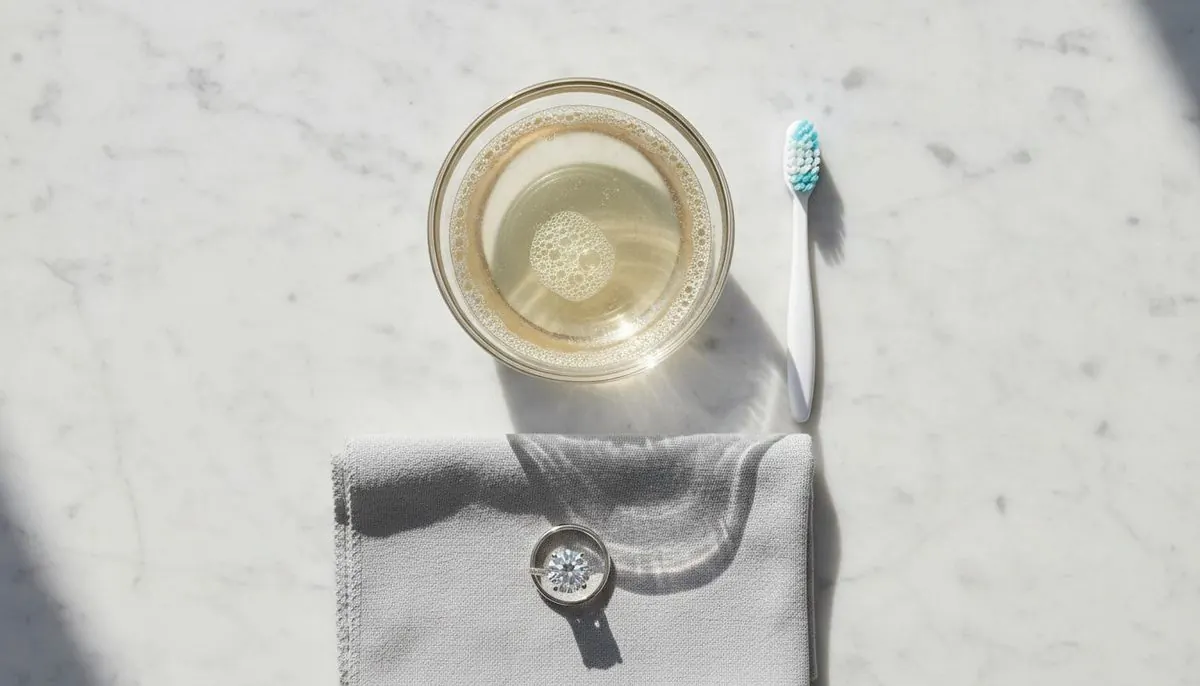
The method
A diamond that looks dull is almost always a dirty diamond. Diamond's surface attracts oil and repels water, the same property mines once used to sort diamonds on grease tables. On your hand that means lotion, soap, skin oil and cooking grease build a film on the underside of the stone, where it blocks light from entering and bouncing back. Clean that off and the stone comes back.
Step by step
- Plug the sink or use a bowl. Every jeweler has heard the story of a ring down the drain. Do not rinse over an open drain.
- Mix warm water with a few drops of mild dish soap. Warm, not hot. Plain grease-cutting dish soap is fine; skip anything with added moisturizers or scrubbing particles.
- Soak for 20 to 40 minutes. This loosens the film so you do not have to scrub hard.
- Brush the underside. Use a soft toothbrush, new and only for jewelry. Work gently under the stone and around the prongs, where grime collects. That is where the light enters, so it matters more than the top.
- Rinse under warm running water to wash the loosened dirt and soap away.
- Dry with a lint-free cloth or let it air dry. GIA advises against paper towels.
- Check the prongs while it is clean. Look for bent or worn tips and gently feel whether the stone moves. A loose stone is a trip to the jeweler, not a cleaning job.
What never goes on a diamond ring
| Product | Verdict | Why |
|---|---|---|
| Chlorine bleach | Never | GIA warns chlorine can damage the metals alloyed into gold settings |
| Abrasive cleaners, toothpaste, scouring powder | Never | Scratch the metal and any softer stones in the piece |
| Pool and hot tub water | Take the ring off | Chlorine again, and repeated exposure is worse than one splash |
| Hot water from the kettle | No | Sudden temperature changes can stress some stones and settings |
| Mild dish soap and warm water | Yes | GIA's recommended solution |
| Commercial jewelry cleaner | Fine if labeled safe for your stones | Read the label; it is not better than soap and water |
Ultrasonic and steam cleaners: when they are safe
Ultrasonic cleaners shake dirt loose with high frequency vibration in a liquid bath. Steam cleaners blast it off. Both work well on a solid, untreated diamond in a sound setting. Both can cause damage in the cases below, and GIA's advice is to check the grading report for treatments and ask a jeweler first.
| Situation | Ultrasonic | Why |
|---|---|---|
| Untreated diamond, secure prongs | Generally OK | Diamond is tough enough for it |
| Fracture filled (clarity enhanced) diamond | No | GIA says avoid; vibration and heat can damage the filling |
| Pavé or stones set edge to edge | Ask a jeweler | Vibration can chip girdles where stones touch |
| Loose or worn prongs | No | It can shake the stone out of the setting |
| Diamonds with pearls, opal, emerald or turquoise | No | Those gems are soft, porous or often treated |
| Moissanite or lab grown diamond | Generally OK | Same rules: check the setting first |
If you do not know whether your diamond is fracture filled, assume it might be and stick to soap and water. Fillings are disclosed on lab reports, and our clarity chart explains why some lower clarity stones get them.
How often to clean
There is no official schedule. Here is what works for a ring worn every day:
| Task | How often | Who |
|---|---|---|
| Quick soak and soft brush | Every week or two | You |
| Prong and setting check | Every time you clean | You |
| Professional clean and inspection | Once or twice a year | Jeweler |
| Re-tipping worn prongs | When the jeweler says so | Jeweler |
The professional inspection is the part people skip, and it is the one that saves the stone. A jeweler checks prongs under magnification and can rebuild worn tips before the diamond falls out.
Habits that keep it clean longer
- Put the ring on after lotion, sunscreen, hairspray and makeup, not before.
- Take it off for cooking with your hands, gardening, the gym and cleaning with chemicals.
- Avoid touching the stone itself; pick the ring up by the band.
- Store it apart from other jewelry. Diamond scratches almost everything, including other diamonds.
Adjust for the metal
| Metal | What to know |
|---|---|
| Platinum | Tough and does not tarnish. Soap and water is all it needs |
| Yellow or rose gold | Soap and water. Keep it away from chlorine, which can attack the alloy |
| White gold | Usually plated with rhodium. The plating wears with time and exposes a warmer tone; a jeweler can replate it |
| Sterling silver | Tarnishes. Use a silver cloth on the metal, and keep polish away from the stone |
| Plated or costume metal | Short soak only, no scrubbing of the plating; often a sign the stone is not diamond |
Still dull after cleaning?
If the stone looks lifeless even when clean and dry, one of these is the reason:
- Film left behind. Soap residue counts. Rinse longer under warm running water.
- Grime packed under the stone. Old buildup behind a closed setting can resist a toothbrush. A jeweler can steam or ultrasonic it if the stone and setting allow.
- Cut. A poorly proportioned diamond leaks light no matter how clean it is.
- It is not a diamond. Worn, rounded facet edges and a scratched table point to cubic zirconia or glass. Our list of fake diamond signs helps.
Moissanite, lab grown and CZ
The same method works for all of them. A lab grown diamond is diamond, so every rule above applies unchanged. Moissanite, at 9.25 on the Mohs scale, handles soap, water and a soft brush just as well, and is generally fine in an ultrasonic if the setting is sound. Cubic zirconia is softer, so skip anything abrasive and do not scrub hard; scratches on a CZ do not polish out at home. If you do not know which stone you have, clean it gently as if it were the softest of the three. Our post on what moissanite is explains why it holds up so well.
Cleaning before you test a stone
If you are cleaning because you want to check whether the stone is real, you are doing it in the right order. A greasy film ruins the flashlight test and slows the fog test on a real diamond, so either can give a false result on a dirty stone. Clean, dry, then test. Start with the fog test and the flashlight test, and use how to tell if a diamond is real for the full list.
Our take
Warm water, a drop of dish soap and a soft toothbrush handle routine cleaning, cost nothing and cannot damage a diamond. Use an ultrasonic only on untreated stones in solid settings, never use bleach, and let a jeweler look at the prongs once or twice a year. A clean, well cut diamond is what you paid for; our cut grades guide explains why cut is what makes it sparkle in the first place.
FAQ
What is the best thing to clean a diamond ring with?
Can I use an ultrasonic cleaner on my diamond?
Does Windex or vinegar clean diamonds?
Why does my diamond look cloudy?
Sources
Worth being clear: everything here, and the app itself, is an educational reference. At-home tests narrow things down, they do not certify a stone. Before you buy, sell or insure anything of real value, get it looked at by a certified gemologist or an independent appraiser.
Want a second opinion on the stone in your hand?
Diamond Tester reads a photo and gives you its visual take on the stone, the 4Cs and a value range, plus what to check next. It does not replace a jeweler's tester or a lab report. First scan is free on iOS and Android.


Keep reading
FL to I3 in plain English.
The fog testHow to do it and what it proves.
Diamond cut gradesWhy cut beats every other C.
Where to get a diamond testedFree counter tests, paid appraisals and lab reports. Which answers your question and what each one costs.
How to use a diamond testerThe routine that removes most wrong readings, how to read the lights, and how to test a stone that is still set.